Insanity
Young Captain Jack · The Son of a SoldierInsanity is presented as the traumatic aftermath of shipwreck, war, separation, and medical abuse, but also as a label that can be imposed for criminal advantage. Colonel Stanton’s apparent mental disorder obscures his identity and family history for years, while Dr. Mackey manipulates the institutions meant to treat him. The condition therefore functions on two levels: it records the damage inflicted on a man’s body and memory, and it exposes how easily medical authority can be converted into a mechanism of imprisonment and dispossession.
Traumatic Memory and the Shipwreck
Insanity first appears indirectly through Colonel Stanton’s fevered speech while he lies wounded. The colonel is unable to recognize Mrs. Ruthven clearly, mutters for a long time, and suddenly cries, "The ship is doomed!" before describing a vessel breaking against rocks. His language joins the remembered shipwreck to the terrible battle through which he has recently passed, so that military trauma and maritime disaster become entangled in a single disordered mental landscape.
His subsequent delirium supplies fragments of the lost family history. He cries that Laura must be saved, asks where the child is, calls the child his darling Jack, and alternates between images of waves, rebels, retreat, and victory. The speech is not presented as a coherent account; it arrives as a rush of alarmed questions, commands, and repetitions. Yet its apparent disorder contains precise names and relationships. Mrs. Ruthven notices that the colonel’s face perfectly resembles Jack’s, and the fevered references to Laura and a son named Jack transform insanity from a sign of confusion into an accidental witness to the past.
This pattern recalls Jack’s own incomplete childhood memory. He remembers only a storm and enormous waves in a dreamy, uncertain way, while the surviving objects connected with the wreck include his mother’s unmarked lace handkerchief and a ring kept by Mrs. Ruthven. The wreck on Hemlock Bluff, the name Laura, the ring, and the child’s name thus operate as recurring triggers and corroborating clues. Memory is fragmented, but it is not empty: physical traces and repeated verbal remnants gradually give its fragments a historical shape.
Confinement and Medical Exploitation
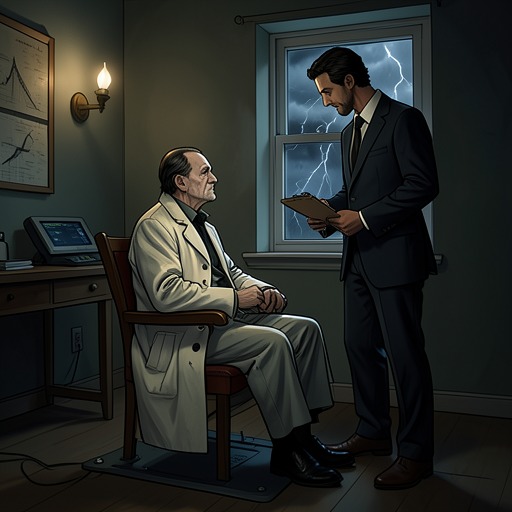
Colonel Stanton later explains that exposure affected both his body and his mind. After being rescued from the sea, he was carried through a voyage lasting several weeks, spent two months in a strange hospital, and was then transferred to an insane asylum. He describes the asylum as a place where he was treated brutally by a physician who tried to extract information about his family affairs. The account establishes that his confinement was not merely the result of an unexplained illness; it followed physical catastrophe and was intensified by deliberate mistreatment.
The physician was known as Mackenzie, though the Colonel later learned that his real name was Mackwell or Mackey. This identification connects the Colonel’s damaged memory to Dr. Mackey’s later attempt to seize Jack. The same man who investigated the Colonel’s family history also becomes the central threat to the Colonel’s surviving child, making the asylum an important link between past suffering and present conspiracy.
During lucid intervals, Dr. Mackey induced the Colonel to disclose that property in England was coming to him and that an estate in Virginia was due to Laura. The ocean voyage had been undertaken to secure Laura’s inheritance. After extracting these details, the physician drugged him, leaving him scarcely aware of what happened for a long period. When the Colonel recovered his mind, Mackey had already left the asylum. The alleged illness thus served a material purpose: it gave Mackey access to confidential family information and time to pursue the property.
The confinement continued for years because Mackey entered the Colonel’s name in the asylum records as incurable and subject to attacks of great violence. That administrative description had practical force. It converted a vulnerable survivor into a supposedly permanent patient and prevented his testimony from carrying ordinary legal or social authority. The novel’s contrast between the Colonel’s lucid recollection of these events and the false institutional record makes insanity a question not only of mental condition but also of who possesses the power to define a person.
From Apparent Madness to Evidence
The Colonel’s fevered declarations initially seem too disordered to establish anything. Mrs. Ruthven wonders whether his talk of a doomed ship means that he once survived a wreck, and she remains uncertain whether the woman named Laura was truly Jack’s mother. The recognition depends on accumulation rather than a single revelation: the Colonel’s words, his resemblance to Jack, the remembered circumstances of the wreck, the preserved ring and handkerchief, and the later history of Mackey’s interest in the family fortune converge.
This convergence changes the narrative meaning of the Colonel’s insanity. His speech is unreliable as a chronological account, but it proves valuable as involuntary testimony. The very repetitions that mark his damaged state preserve names, emotional priorities, and family bonds. Laura is repeatedly placed in danger, Jack is repeatedly identified as the child to be saved, and the shipwreck returns as the scene from which the family was separated. The account therefore treats traumatic recollection as belated and fragmentary while allowing external evidence to test and complete it.
The recovery of the black tin box from the wreck provides a further material counterpart to the Colonel’s unstable memory. The box is found hidden in a dirty, water-damaged closet and later recovered from the guerrillas’ camp after the men who held Jack prisoner are killed in battle. Its contents are eventually turned over to Colonel Stanton, who recognizes the papers as his precious documents and declares that nothing now stands between him and his fortune. The papers do not erase the years of confinement, but they give documentary force to the identity and inheritance that Mackey tried to suppress.
Consequences and Narrative Significance
Insanity separates Colonel Stanton from his wife Laura, his child Jack, and the property that should have belonged to his family. It also creates the conditions for Mackey’s fraud: by presenting the Colonel as incurable and dangerous, Mackey can hide the living heir while investigating the inheritance and later claim authority over Jack. The condition therefore produces consequences far beyond private suffering, affecting adoption, parentage, property, and the legal recognition of family.
The novel nevertheless refuses to leave the Colonel inside the identity imposed by the asylum. His mind contains enough surviving connection to the past for names, images, and relationships to re-emerge, and the people around him learn to read those fragments against physical and documentary evidence. Recovery is consequently social as well as psychological. The Colonel’s history becomes credible when Mrs. Ruthven compares his speech and appearance with Jack’s story, when Mackey’s conduct exposes his motive, and when the recovered papers confirm the family’s claim.
As a literary device, insanity brings the hidden past into the present without making recollection orderly or complete. The wreck returns in the Colonel’s fever, just as the wreck itself remains present through the ring, handkerchief, and tin box. Repetition becomes a symptom of trauma and a mechanism of recognition. At the same time, the false diagnosis reveals the danger of treating medical authority as unquestionable: Mackey’s abuse turns a damaged man’s vulnerability into a legal and economic prison. By the end, the restoration of Colonel Stanton’s family and fortune depends on exposing the difference between genuine traumatic impairment and the fraudulent story imposed upon him.